
From Foundations to Practice: Operationalizing AI Data Governance
Learn how to operationalize AI data governance through a structured lifecycle approach, ensuring compliance and accountability at every stage.
4 min read
AI is transforming how organizations use data — and how they must govern it. In this first of a five-part series, we explore how AI governance differs from traditional data governance, and why securing data is no longer enough when models are making the decisions.
For decades, organizations have relied on IT and data governance to answer a deceptively simple question: is our data accurate, secure and compliant? That discipline built the foundations of the modern enterprise — data catalogs, access controls, retention schedules and audit trails. But AI systems that learn from data and then act on it have changed the question entirely. It is no longer enough to ask whether the data is safe. We now have to ask whether it is reliable, representative and suitable for training a model that will make or influence autonomous decisions — and whether those decisions are fair, explainable and ethical. This creates two connected new disciplines: AI data governance, which governs the data feeding AI, and AI governance, which governs the models and their outcomes.
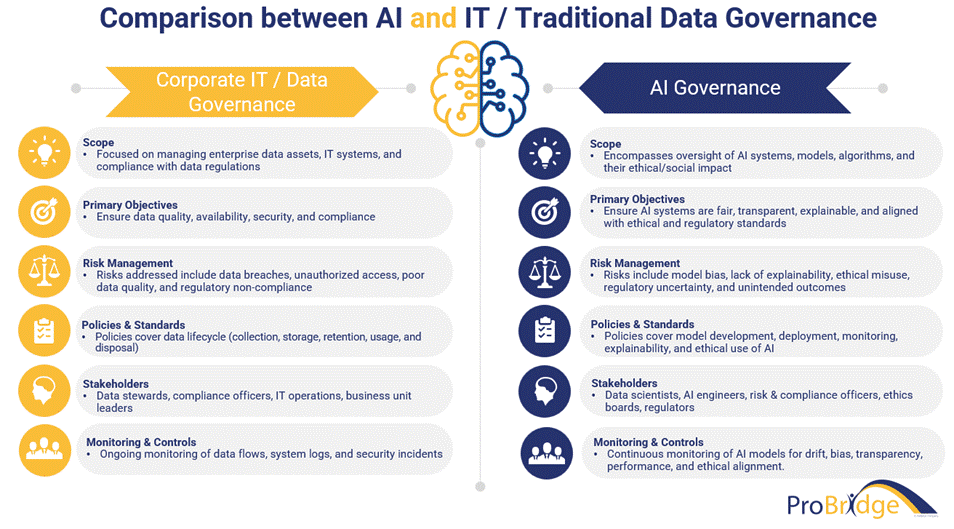
Traditional corporate IT and data governance has a clear, well-bounded mandate: keep enterprise data accurate, available, secure and compliant. Its scope covers enterprise data assets and IT systems, its playbook matured alongside regulations like GDPR, HIPAA and SOX, and its roles are settled: data stewards define quality standards, security teams control access, compliance officers verify legal obligations.
AI governance inherits all of that and widens the aperture dramatically. Its scope encompasses oversight of AI systems, models and algorithms — and, crucially, their ethical and social impact. Traditional governance asks whether a system handles data correctly; AI governance asks whether a system behaves correctly: whether its outcomes are fair to the people they affect, transparent to those who rely on them and aligned with the law and the organization's values. The unit of governance changes: from the data itself to the decision and the model, training data and deployment context that produce it.
Between the two sits AI data governance — traditional data governance re-scoped for data that will train, tune or ground AI systems. A dataset can pass every traditional control and still be unfit for AI use, because fitness for AI raises requirements the classic lifecycle never tested:
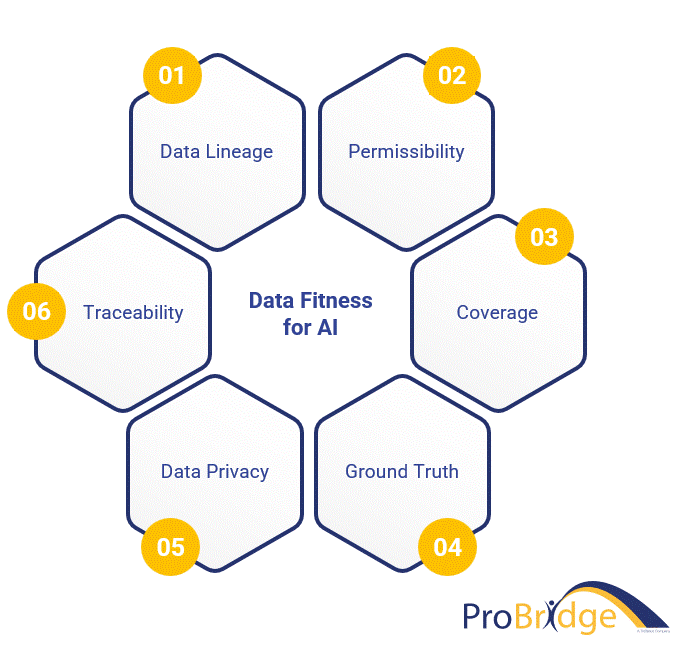
The principle: govern data not only as an asset at rest, but as an ingredient whose defects propagate into every decision the model makes.
Traditional governance aims for data quality, availability, security and compliance — properties of information, where success is largely binary. AI governance aims for something harder: systems that are fair, transparent, explainable and ethically aligned. These are properties of behavior. Fairness is contested and context-dependent; explainability exists on a spectrum; “ethical alignment” requires the organization to first articulate its ethics. Because models actively make or influence decisions — approving loans, screening résumés, prioritizing patients — the objective shifts from protecting an asset to vouching for an outcome. A perfectly secured, compliant dataset can still train a deeply biased model; data quality is necessary but not sufficient.
Traditional governance addresses a stable set of risks — breaches, unauthorized access, poor data quality, non-compliance — with mature controls. AI introduces categories those frameworks were never designed to see: model bias that no firewall detects; decisions even the model's creators cannot fully explain, when regulators increasingly demand explanations; ethical misuse of models repurposed beyond their intent; regulatory uncertainty as frameworks like the EU AI Act take shape unevenly across jurisdictions; and unintended outcomes as models meet the real world. The deeper difference is the nature of these risks: traditional data risks are largely static, while AI risks are dynamic — data drifts, populations shift, models are retrained. A model that was fair at deployment can become biased six months later without a single line of code changing.
Traditional policies follow the data lifecycle — collection, storage, retention, usage, disposal. AI governance adds a second lifecycle: the model lifecycle, covering development, deployment, monitoring, explainability and ethical use, raising questions the data lifecycle never asked; what documentation must accompany a model before deployment, who approves high-stakes use cases, what thresholds trigger retraining or retirement and when a human must review the output. AI data governance is the bridge between the two: it takes the classic lifecycle and adds gates for provenance, consent-for-training and representativeness, so a dataset that is perfectly legal to store is not assumed appropriate to train on.
Traditional data governance is largely internal and technical: data stewards, compliance officers, IT operations and business unit leaders. AI governance dramatically widens that circle — data scientists and AI engineers as builders of the governed systems, risk and compliance officers with algorithmic accountability, ethics boards weighing whether a use case should be pursued at all and regulators as active stakeholders requiring documentation and impact assessments. The expansion reflects the raised stakes: a traditional failure is a breach or a fine; an AI governance failure can be a discriminatory lending pattern or a wrongful denial of benefits. The stakes are no longer just data integrity, but the decisions that shape people's lives.
Traditional governance relies on ongoing but largely mechanical monitoring — data flows, system logs, security incidents — with periodic audits verifying controls. AI systems do not extend that courtesy: models degrade silently as incoming data drifts from the training distribution. AI governance therefore demands continuous monitoring for drift, bias, transparency, performance and ethical alignment — tracking prediction distributions across demographic groups, alerting on data drift and keeping the ability to roll a model back quickly. On the data side, this vigilance extends upstream: pipelines feeding production models must be monitored for schema changes, quality regressions and poisoned or corrupted inputs. Monitoring can never be a one-time checkpoint, because the risks never stop moving.
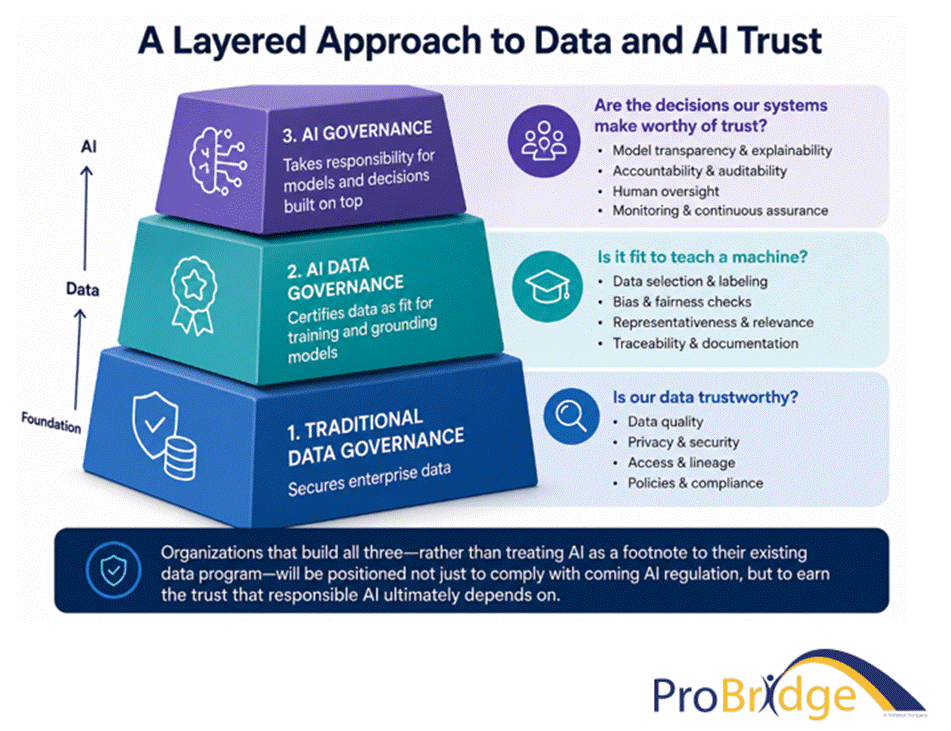
As the diagram shows, the three layers build on one another: traditional governance secures the data, AI data governance certifies it as fit to teach a machine and AI governance answers for the decisions built on top. Organizations that invest in all three — rather than treating AI as a footnote to their data program — won't just comply with coming regulation; they'll earn the trust responsible AI depends on.
Coming up in Part 2: The Pillars of AI Data Governance — the controls that make data fit to teach a machine.

Learn how to operationalize AI data governance through a structured lifecycle approach, ensuring compliance and accountability at every stage.

Explore the six essential pillars of AI data governance that ensure high-quality, secure, and fair data management for trustworthy AI outcomes.

Discover a practical roadmap for establishing an AI governance program, covering foundational steps, core implementations and future considerations.