
Navigating the Global AI Governance Ecosystem
Explore the complex global AI governance ecosystem, its 4 layers and how organizations can align their AI programs with evolving standards and...
5 min read
Over the course of this series, we have built an argument piece by piece. Part 1 drew the line between traditional data governance and AI governance, from guarding data to governing decisions, and introduced the three-layer model with AI data governance as the bridge. Part 2 detailed the six pillars that make data fit to teach a machine. Part 3 turned those pillars into lifecycle gates, and Part 4 mapped the global ecosystem of principles, standards, regulators and ethics bodies that your program can anchor to. This final post answers the question that remains: where do you actually start? What follows is a pragmatic three-phase roadmap — and a look at where governance goes next.
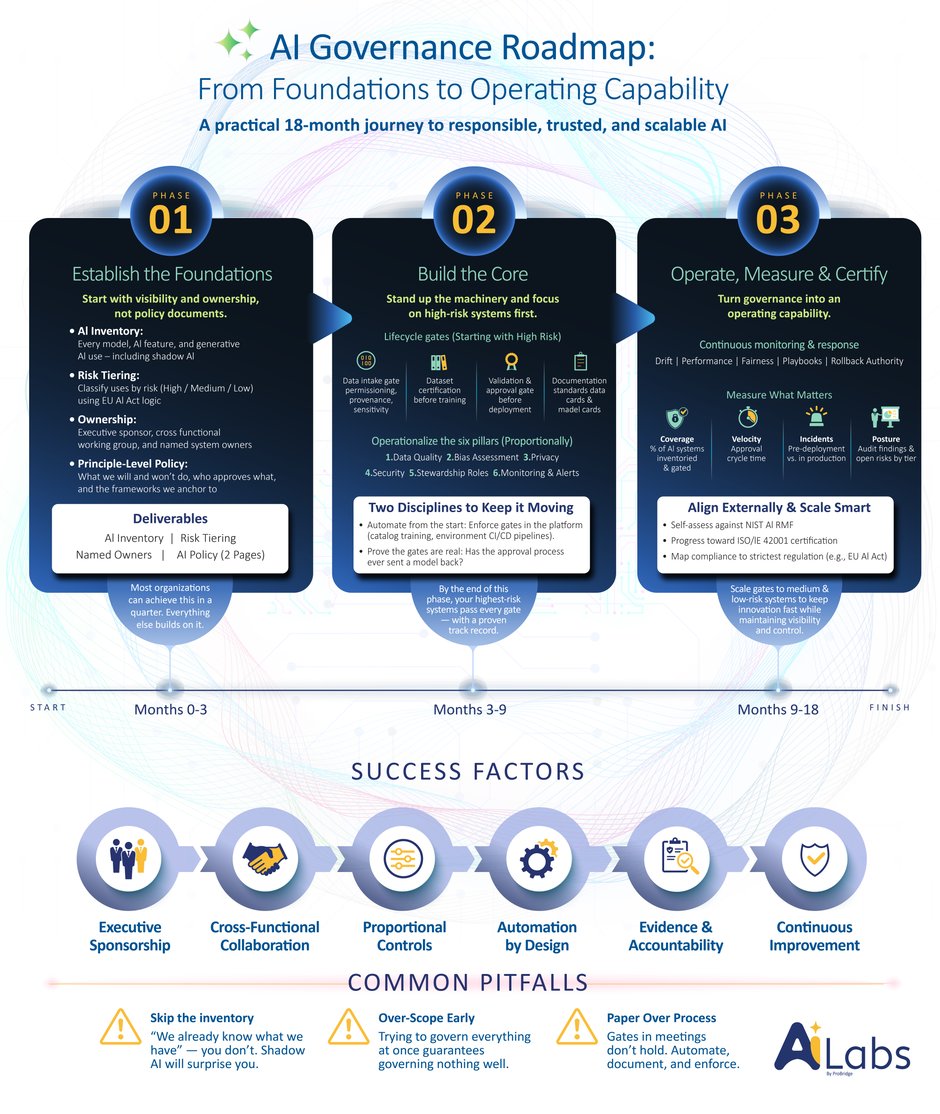
Every durable program starts with visibility and ownership, not policy documents. Begin with an AI inventory: every model, AI feature and generative AI use in the organization — including the shadow AI in business units that no one registered. Classify each use case into risk tiers, borrowing the EU AI Act's logic even where it doesn't legally apply yet: what touches individual rights, money, health or safety is high-risk; internal productivity tools are not. Then assign ownership: an accountable executive sponsor, a small cross-functional working group (data, legal, risk, security and the business) and named owners for the highest-risk systems.
Close the phase with a short, principle-level AI policy: what the organization will and won't do with AI, who approves what and which external frameworks you anchor to. Resist the urge to write a fifty-page policy suite up front; a two-page policy that is actually enforced beats a binder that isn't read. The deliverables of Phase 1 are deliberately modest: an inventory, a risk tiering, named owners and a policy. Most organizations can achieve this in a quarter, and everything else builds on it.
Two pitfalls commonly derail this phase. The first is skipping the inventory because “we already know what we have;” every organization that has actually run one has been surprised, usually by generative AI usage in functions far from IT. The second is over-scoping: attempting to govern everything at once guarantees governing nothing well. The risk tiering exists precisely so the program can concentrate its early energy on the handful of systems where failure would genuinely hurt someone.
With foundations in place, stand up the machinery from Parts 2 and 3, starting where the risk is. Implement the lifecycle gates around your high-risk systems first: the data intake gate (permissibility, provenance, sensitivity), dataset certification before training, the validation-and-approval gate before deployment and documentation standards — data cards and model cards — that make every decision reconstructable. In parallel, operationalize the six pillars proportionally: quality profiling and bias assessment in the data pipeline, privacy checks for training data, security controls including poisoning and leakage protections, and the stewardship roles that give every alert an owner.
Two disciplines keep Phase 2 from stalling. First, automate from the start: gates that live in the platform — enforced by the data catalog, the training environment, and CI/CD pipelines — survive delivery pressure; gates that live in meeting invitations do not. Second, prove the gates are real: the operational test of an approval process is whether it has ever sent a model back. By the end of this phase, your highest-risk systems should pass through every gate, and your review board should have a track record.
The third phase turns a project into an operating capability. Extend continuous monitoring across production models — drift, performance, fairness — with thresholds wired to response playbooks and rollback authority. Establish the metrics that tell leadership whether governance is working: coverage (what share of AI systems are inventoried and gated), velocity (how long approval takes, so governance is a measured cost rather than a mystery), incidents (issues caught pre-deployment versus in production) and posture (audit findings, open risks by tier).
This is also the phase to align externally, converting the anchoring from Part 4 into credentials: a self-assessment against the NIST AI RMF, progress toward ISO/IEC 42001 certification if your market rewards it and a compliance mapping against the strictest regulation you face. Finally, scale down as well as up; extend a lighter version of the gates to medium- and low-risk systems, so experimentation stays fast while nothing escapes the inventory. Governance that is proportionate earns cooperation; governance that treats every chatbot like a credit model earns workarounds.
Mature programs share observable traits. Every AI system in production can name its owner, its training data version and its last validation date. Time-to-approval is predictable and published. At least one model has been sent back, and at least one has been rolled back; proof the controls have teeth. Regulator and customer questionnaires are answered from standing documentation rather than scrambles. And the tone has shifted: business teams bring use cases to governance early, because the path through is clear, rather than around, because it isn't. When a program reaches that state, governance has stopped being a gate at the end and become part of how the organization builds.
Governance is aiming at a moving target, and four shifts deserve a place on your horizon. Agentic AI, systems that plan and act across tools rather than answer single prompts, stretches the decision-centric governance of Part 1 further: oversight must now cover chains of actions, delegated authority and the boundaries of what an agent may do unattended. Generative and frontier models blur the training-data question — governing what goes into a foundation model you didn't build means governing your vendors, your fine-tuning data and your grounding data with the same pillars. Synthetic data will move from workaround to mainstream input, making the validation and lineage disciplines from Part 2 more important, not less. And governance itself is being automated: AI systems that monitor other AI systems for drift, bias and policy violations, which is a capability worth building, and a recursion worth governing.
Underneath all four runs a fifth shift: convergence. As Part 4 described, the ecosystem's expectations are consolidating around a shared core: transparency, accountability, human oversight, documented control of data and models. The practical consequence is that governance investments compound rather than fragment: the model card written for an internal review board serves the ISO auditor, the EU AI Act technical file and the enterprise customer's due-diligence questionnaire. Early movers are not just reducing risk; they are amortizing one body of work across every audience that will ever ask.
For readers who want the whole series compressed into a first month of action: pull together the working group and start the AI inventory this week — a shared spreadsheet beats waiting for a tool. Risk-tier what you find, pick your single highest-risk system, and walk it through the questions this series has posed: where did its training data come from, who approved it, what would tell you it has drifted, and who could switch it off tonight if it misbehaved? The gaps that exercise exposes are your roadmap, in priority order. Then write the two-page policy, anchor it to NIST AI RMF or ISO/IEC 42001, and schedule the first review board session with real authority to say no. None of this requires new technology to begin; it requires ownership, a list and the willingness to look.
We began this series with three questions, one per layer: Is our data trustworthy? Is it fit to teach a machine? Are the decisions our systems make worthy of trust? The roadmap above is simply the organizational work of being able to answer yes, with evidence, to all three. That work is no longer optional: regulation is arriving, customers are asking and AI systems are making decisions that shape people's lives. But the deeper case was never compliance. Organizations that can stand behind their data, their models and their decisions will move faster with AI, not slower, because trust is the license under which ambitious deployment operates. Traditional governance guards the data. AI data governance certifies it. AI governance answers for the decisions. Build all three, and you haven't constrained your AI ambitions — you've earned the right to pursue them.

Explore the complex global AI governance ecosystem, its 4 layers and how organizations can align their AI programs with evolving standards and...

Explore the six essential pillars of AI data governance that ensure high-quality, secure, and fair data management for trustworthy AI outcomes.

Learn how to operationalize AI data governance through a structured lifecycle approach, ensuring compliance and accountability at every stage.