
Leading with AI in 2026: NPV Modeling and Intelligent Decision-Making for Credit Unions
Discover how AI and NPV modeling together enhance decision-making for credit unions, driving value and improved member experiences in 2026.
4 min read
How financial institutions can turn the data they already own into an AI analyst their teams can simply talk to.
Every credit union is sitting on a wealth of data — member activity, loan performance, deposits, applications — most of it already organized inside a modern data warehouse. Yet for the average employee, getting a straight answer out of that data still means filing a request, waiting in a queue and relying on a busy analyst to write the query. The information exists; the access does not.
Snowflake’s AI capabilities are changing that equation. With a thoughtfully built semantic model, a credit union can stand up an AI analyst that any employee can talk to in plain English — and get back an answer grounded in the institution’s own governed data. This article walks through how that system fits together, from the data warehouse at the foundation all the way to a monitored, production-ready AI agent.
It helps to think of Snowflake’s AI ecosystem as five connected layers that build on one another. At the foundation is your data warehouse; the governed tables, views and curated models you already maintain. On top of that sits Cortex Analyst, the semantic layer that translates a plain-language question into correct SQL. Above that, an agent wraps the analyst in a conversational interface that people can actually use. Cortex Code, an AI-assisted workbench, supports the whole effort behind the scenes, and Cortex Playground rounds things out for quick, ad-hoc model queries.
The key idea is that each layer is only as strong as the one beneath it. A capable agent depends on a well-trained analyst, which in turn depends on clean, well-modeled warehouse data. Get the foundation right and everything above it becomes dramatically easier.
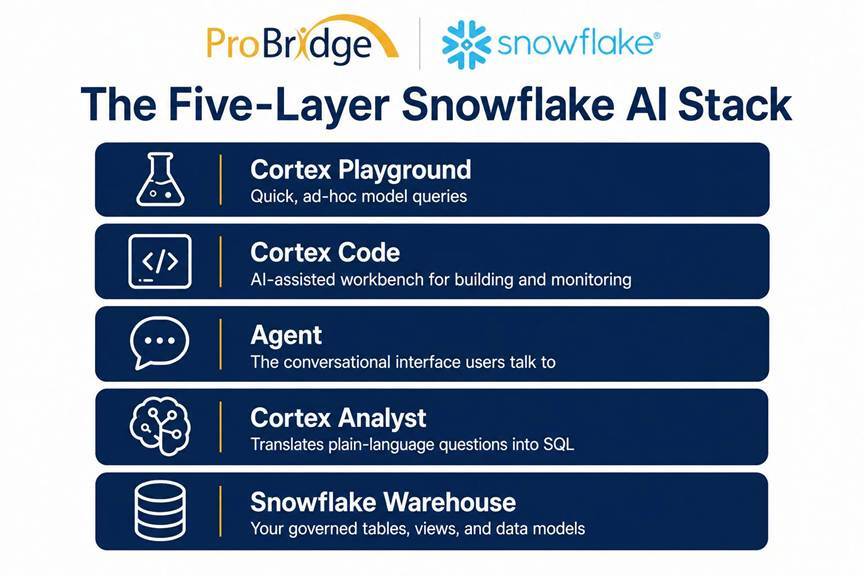
The five-layer Snowflake AI stack: each layer builds on the one beneath it.
Before any AI enters the picture, the real work is building the right data models. That means identifying the most important tables and fields — the ones that actually answer the questions the business asks every day — and shaping them into clean, business-ready models inside Snowflake. This foundation has to deliver a governed source of truth where definitions are agreed upon, dependable joins that hide the messy logic, consistent column semantics and the access controls the AI will inherit automatically.
There is a powerful, often-overlooked bonus here. The same data models you build to power an AI analyst can also power your existing business intelligence. Institutions that once routed data from a separate SQL Server into Tableau can point those same dashboards directly at Snowflake’s data sources instead. The result is faster, more seamless refreshes and a single, consistent source of truth feeding both your dashboards and your AI. In other words, the investment pays off twice.
Cortex Analyst is the layer that sits between your people and your warehouse. Defined as a structured semantic model, it carries the business logic, metrics and relationships that give raw tables meaning. When an employee asks, “What was our loan approval rate this quarter?” the analyst maps that question to the right tables and measures, generates valid SQL against Snowflake, and returns a grounded answer — no analyst required in the loop.
Three principles are worth keeping in mind. First, the analyst is semantic, not lexical: it interprets the meaning of a question rather than matching keywords. Second, it is only as capable as the model behind it — the semantic file is its brain. And third, it is fully trainable and correctable, which is what turns a promising demo into a trustworthy production tool.
Training happens in two complementary parts. The first is verified queries — pairings of a real business question with the known-correct SQL that answers it. A strong shortcut is to build these directly from the SQL logic your team already trusts for its dashboards, so the analyst’s answers line up precisely with the numbers stakeholders already rely on.
The second part is custom instructions, which capture an institution’s tribal knowledge — the unwritten rules that live in the heads of veteran analysts. These come in two forms: rules about how a number is calculated (for example, the precise definition of a funded versus a booked loan) and rules about how results should be presented (for example, always breaking a delinquency report into the specific buckets a team expects). Gathering this knowledge is simply a matter of sitting down with the teams and data stewards who own each domain and encoding what they tell you. The more context you provide, the better the analyst performs.
Once the analyst understands the business, it is wrapped in an agent — a conversational interface that feels much like a familiar chat assistant. The agent calls on the analyst as a tool, and it adds capabilities the semantic layer alone cannot: multi-turn conversations that remember context, document uploads, orchestration across multiple queries and tools, and per-user permissions inherited directly from Snowflake.
Crucially, the agent has its own layer of instructions governing how it behaves — separate from what the data means. Here a credit union can mask sensitive fields such as member numbers by default and reveal them only on explicit request, set a consistent tone, append a standard disclaimer reminding users to validate AI-generated figures before acting on them and define workflows that run a fixed sequence of trusted queries for common requests like a 360-degree view of a member.
An AI analyst is only as valuable as it is accurate, so every answer is validated against a source of truth — typically the production dashboards the business already trusts, cross-checked against hand-written SQL. The goal is to bring variance between the analyst and that source of truth to within a tight threshold, often under one percent. Reaching that level is genuinely hard and rarely perfect on the first pass; it takes repeated cycles of asking, comparing, correcting and retesting.
And the work does not stop at launch. Once an agent is in production, every interaction — the questions asked and the SQL generated — can be captured and analyzed to understand how it is really performing. Layering in direct user feedback, where people rate each response and explain what worked or did not, turns the system into a continuously improving loop. A data team can only take an analyst so far on its own; a real user base providing real feedback is what makes it genuinely effective over time.
Semantic AI on Snowflake is not a single feature you switch on — it is a lifecycle. You start with clean, governed data models, give them meaning through a semantic layer, train that layer with verified queries and institutional knowledge, deliver it through a conversational agent and then validate and monitor it continuously in production. For credit unions, the payoff is twofold: employees gain instant, plain-language access to trustworthy data, and the very same models strengthen the dashboards and reporting the institution already depends on.
The data is already there. Semantic modeling is how you finally put it within everyone’s reach.

Discover how AI and NPV modeling together enhance decision-making for credit unions, driving value and improved member experiences in 2026.

Explore why data quality is crucial for credit unions in today's digital age and how a strong data culture drives success and member satisfaction.

Unlock your credit union's potential with ProBridge's custom predictive models, driving growth and member engagement through actionable data...